

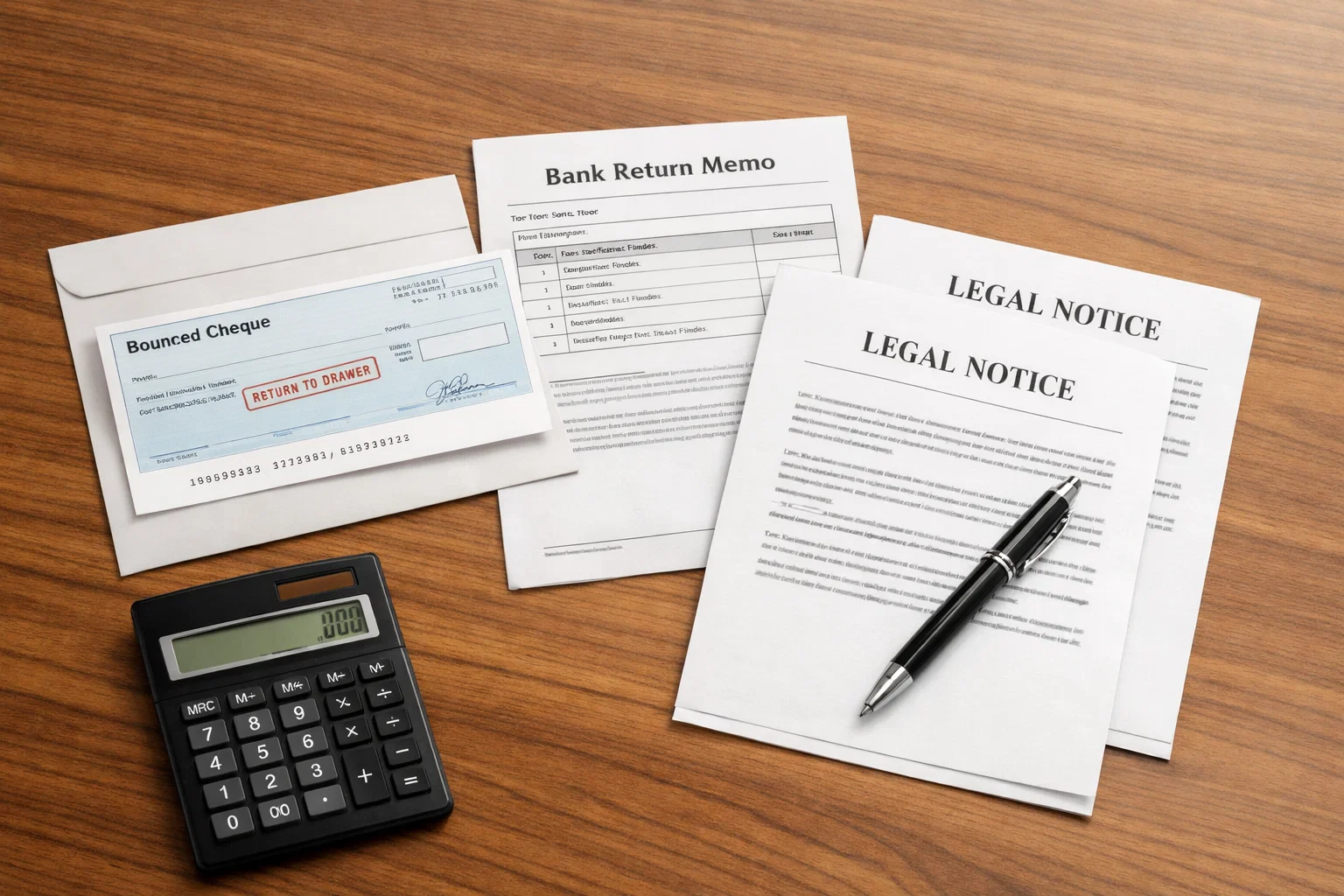
In India, cheques are still widely used for business payments, loans, rent, and personal transactions. Many people believe that if a cheque bounces, it is only a banking issue. However, under Indian law, a cheque bounce can become a serious legal matter if proper steps are not taken in time.
This article explains, in a simple and clear manner, what a cheque bounce is, why it attracts legal action, and what remedies are available to the affected person.
Table of Contents
1. What Is a Cheque Bounce?
A cheque bounce happens when a cheque is presented to the bank for payment and the bank returns it unpaid. The bank gives a return memo mentioning the reason for dishonour.
Common reasons for cheque bounce are:
- Insufficient balance in the account
- Account closed
- Signature mismatch
- Stop payment instruction
- Expired cheque
- Errors or overwriting on the cheque
The return memo issued by the bank is an important document and should be safely preserved.
2. Is Every Cheque Bounce a Crime?
No. A cheque bounce becomes a legal offence only when:
- The cheque was issued for repayment of a legally enforceable debt or liability, and
- The legal procedure and timelines prescribed by law are followed
If these conditions are satisfied, legal action can be taken against the person who issued the cheque.
3. Legal Steps to Be Followed After a Cheque Bounces
Indian law requires a fixed procedure. Skipping any step or missing deadlines can weaken or even cancel the case.
Step 1: Collect the Cheque Return Memo
Once the cheque is dishonoured, the bank will return:
- The original cheque, and
- A cheque return memo stating the reason
The date mentioned on this memo is very important because all legal timelines start from this date.
Step 2: Send a Legal Notice Within 30 Days
Within 30 days from the date of receiving the return memo, the payee must send a legal notice to the person who issued the cheque.
The notice should clearly mention:
- Cheque number, date, and amount
- Reason for cheque bounce
- Demand for payment
- A time period of 15 days to make the payment
This legal notice is compulsory. Without issuing this notice, a cheque bounce case cannot be filed.
The notice should be sent by registered post or any mode that gives proof of delivery.
Step 3: Wait for 15 Days
After the notice is received, the drawer of the cheque is given 15 days to pay the amount.
If the payment is made within these 15 days, the matter ends and no court case can be filed.
If the payment is not made, the right to file a case arises.
Step 4: File a Criminal Case
If payment is not received within the 15-day period, the payee can file a criminal complaint within the next 30 days before the Magistrate Court having jurisdiction.
Documents required include:
- Original cheque
- Bank return memo
- Copy of legal notice
- Proof that the notice was delivered
After examining the complaint, the court may issue summons to the accused.
4. Punishment for Cheque Bounce
If the accused is found guilty by the court, the punishment can be:
- Imprisonment up to two years, or
- Fine up to twice the cheque amount, or
- Both imprisonment and fine
Courts usually encourage settlement if the accused is willing to pay the amount.
5. Civil Remedy – Money Recovery Case
Apart from criminal action, the payee can also file a civil case to recover the cheque amount.
Through a civil suit, the payee can claim:
- The cheque amount
- Interest
- Compensation, if applicable
Civil and criminal cases can be filed at the same time.
6. Settlement and Compounding
Cheque bounce cases can be settled at any stage of the proceedings. Many cases are resolved through:
- Mutual settlement
- Lok Adalat
- Court-compounded settlements
Settlement helps both parties save time, money, and mental stress.
7. Important Points to Remember
- Legal timelines are very strict
- Legal notice must be sent within 30 days
- Proof of notice delivery is important
- The cheque must relate to a valid debt or liability
- Proper documents should be preserved
Conclusion
A cheque bounce in India is not just a banking issue. It has serious legal consequences if handled casually. At the same time, the law provides clear remedies to protect the rights of the person who received the cheque.
By following the correct legal procedure within the prescribed time, a cheque bounce issue can be effectively resolved either through court action or settlement.