

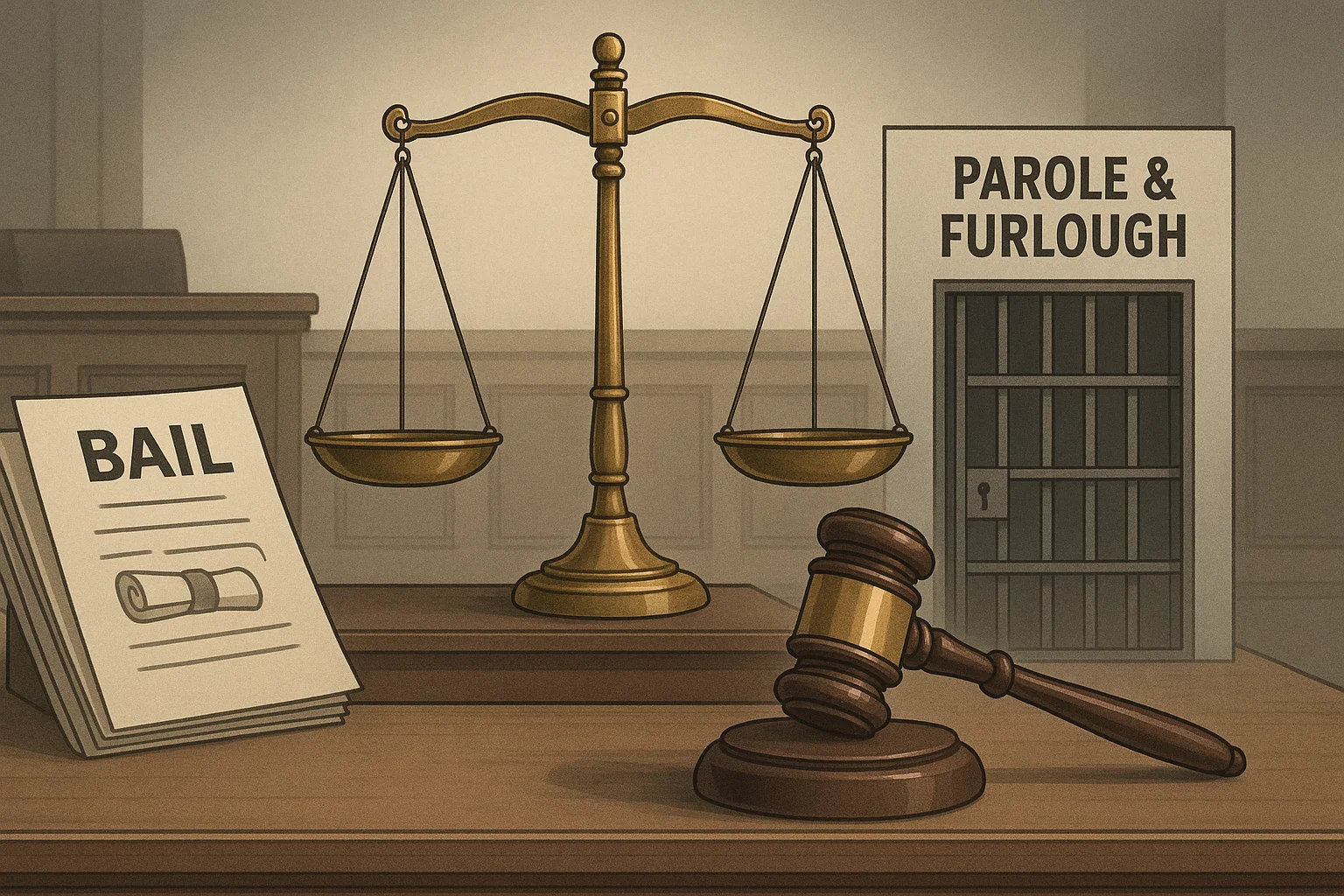
The terms bail, parole, and furlough are often used casually, sometimes interchangeably. But in law, these three concepts are very different. They apply at different stages of the criminal process, have different purposes, and are governed by different legal principles.
This post explains each concept in simple language, with the latest applicable legal framework in India.
1. What is Bail?
Bail gives temporary freedom to a person who has been accused of a crime but has not yet been convicted. It is based on the principle that a person is innocent until proven guilty. Until a court decides otherwise, the accused should not be unnecessarily deprived of liberty.
When Bail Applies
Bail applies to under-trial prisoners, that is, people facing investigation or trial.
Legal Basis
In India, the law of bail is governed by the Bharatiya Nagarik Suraksha Sanhita (BNSS), 2023, which replaced the Code of Criminal Procedure, 1973.
Important provisions include:
- Section 478: Bail in bailable offences
- Section 480: Bail in non-bailable offences
- Section 482: Anticipatory bail
The structure is similar to earlier CrPC provisions, but BNSS adds reforms for transparency and procedure.
Why Bail is Granted
Courts consider factors such as:
- Nature and seriousness of the offence
- Criminal history, if any
- Likelihood of the accused running away
- Possibility of tampering with evidence or influencing witnesses
- The accused’s social ties and roots in society
Bail may be subject to conditions such as bond, surety, surrendering passport, regular court appearance, or restrictions on travel.
What Bail Is Not
Bail does not mean acquittal.
It does not wipe away the charges.
It simply allows the accused to remain outside jail while trial continues.
2. What is Parole?
Parole is the temporary release of a convict from prison after conviction. It is not meant to review the sentence or undo punishment. Instead, parole allows a prisoner to be released for a specific reason and for a limited period.
Reasons for Parole
Parole is largely granted for humanitarian or emergency situations, such as:
- Death of a family member
- Serious illness in the family
- Marriage of a close relative
- Rehabilitation needs
- Other compelling grounds
Legal Framework
There is no single central statute that uniformly regulates parole in India. It is governed by:
- The Prisons Act, 1894
- State Prison Rules or Jail Manuals
- Court-made law through judgments
Because of this, eligibility, duration, and procedure vary across states. Some states have more liberal rules, while others impose stricter restrictions.
Nature of Parole
Parole is discretionary. The authorities evaluate:
- Conduct of the prisoner
- Risk of absconding
- Nature of the offence
- Impact on society or victim
- Previous misuse of release
It can be revoked if conditions are violated.
Sentence Calculation
Time spent on parole generally does not count as time served in prison. It is treated as suspension of sentence. After parole ends, the convict must return to prison and continue the remaining sentence.
3. What is Furlough?
Furlough is also a temporary release of a convicted prisoner, but it is fundamentally different from parole in purpose.
Furlough is not emergency-based. It is a period of leave given to long-term prisoners to maintain psychological and social health. It is designed as part of a reformative approach.
Purpose of Furlough
- To reduce the mental impact of long-term confinement
- To help prisoners maintain family ties
- To promote social reintegration
- To encourage good conduct in prison
Unlike parole, furlough is linked to the prisoner’s overall behavior, not to urgent circumstances.
Legal Framework
Like parole, furlough is governed by prison manuals and state rules. Each state defines conditions such as:
- Minimum sentence served
- Good conduct
- Frequency at which furlough is allowed
- Restrictions on prisoners convicted of heinous offences
Sentence Calculation
The most important difference:
Time spent on furlough counts as part of the sentence. It is treated as remission. The prisoner’s sentence continues to run during furlough.
Key Differences in One Line Each
- Bail is for an accused person before conviction.
- Parole is for a convicted prisoner who needs temporary release for specific reasons.
- Furlough is for a convicted prisoner to maintain social and mental stability as part of rehabilitation.
Example to Understand
A person is arrested for a financial offence. The court grants bail because he has no criminal record, is not a flight risk, and can attend trial. He remains free while the case proceeds.
This is bail.
Later, he is convicted and serving a seven-year sentence. His father becomes seriously ill. He applies for parole and is allowed to stay with family for thirty days. After that, he returns to prison.
This is parole.
After serving several years with good conduct, he is allowed a short annual leave from prison to stay with his family. His sentence continues to run during this period.
This is furlough.
Supreme Court Perspective
The Supreme Court has repeatedly held that:
- Parole and furlough are reformative measures.
- They are not absolute rights.
- Their purpose is different: parole is for special reasons, while furlough is periodic relief.
- Conduct, criminal risk, and public safety remain central.
These concepts are intended to strike a balance between punishment and rehabilitation.
Why Parole and Furlough Matter
Long sentences create severe psychological and social harm. A prisoner may lose family bonds, community connection, and mental stability. When they return to society, they often face isolation, adjustment problems, and higher chances of reoffending.
Controlled release through parole and furlough reduces these risks. It helps maintain human dignity and supports reintegration. Ultimately, society benefits when people who complete their sentences return as functioning members rather than resentful, broken individuals.
Conclusion
Bail, parole, and furlough are three distinct legal mechanisms.
Bail protects the liberty of the accused before guilt is proven.
Parole provides temporary relief after conviction for serious or compassionate reasons.
Furlough offers rehabilitative leave to long-term prisoners as part of correctional philosophy.
Understanding these differences prevents confusion, reduces stigma, and promotes a healthier view of justice. A legal system must punish when necessary, but it must also offer avenues of fairness, humanity, and reintegration.